
Why Counterfeiters Avoid Casino Chips
By Bradley Schagrin

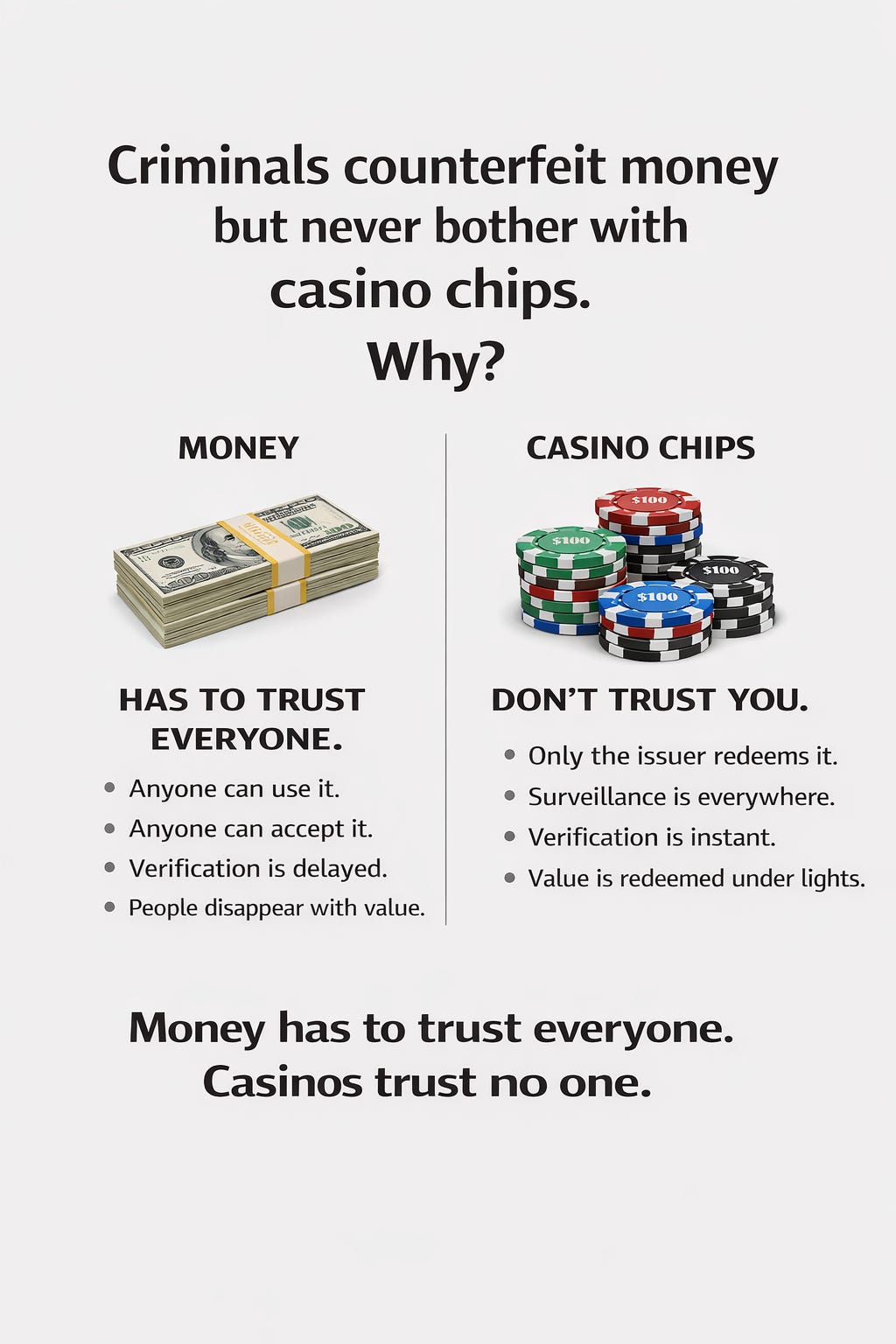
There’s a simple question that sounds trivial until it starts explaining a lot of things you didn’t realize you’d never actually thought through.
Not saying you were thoughtless.
Just… busy. Like the rest of us.
Why do people counterfeit currency all the time, but almost never counterfeit casino chips?
I always wondered. Not that I was planning to try—purely academic curiosity, obviously—but when I was younger it seemed like casino chips would be easier. They’re colorful. Physical. Worth real money. Some of them are worth a lot of money.
Meanwhile, modern currency looks like it was designed by a paranoid graphic designer who hasn’t slept since 1987. Watermarks. Holograms. Threads. Special inks. Microprinting. Tiny angry warnings from central banks that feel oddly personal.
Come on. The chips should be easier to fake.
And yet—counterfeiters don’t bother.
They don’t even give it a second thought.
That’s not because casino chips are magically secure.
It’s because they live in a completely different trust universe.
Money Has a Nasty Requirement
Currency has one brutal requirement—one counterfeiters would probably describe as deeply unfair:
It has to work between strangers.
You can hand a bill to someone you’ve never met, in a place you’ve never been, with no authority present, and both of you are expected to agree it’s real. That’s not a bug. That’s the feature.
So money is designed for:
universality,
anonymity,
portability,
and delayed—or sometimes no—verification.
Anyone can accept it. Anyone can inspect it. And if it turns out to be fake, that discovery usually happens after the transaction. Somewhere else. By someone else.
Cue embarrassment.
Confiscation.
Customer yelling.
Possibly the police.
Always the awkward silence.
That delay is everything.
Counterfeiters love systems where:
creation is cheap,
circulation is massive,
detection is slow,
and consequences are pleasantly diffuse.
Currency checks every box.
Casino Chips Don’t Trust You. At All.
Casino chips look like money—though even they raise an eyebrow about it—but they aren’t really money.
They’re access tokens.
A chip has value only inside one tightly controlled environment. You can’t spend it at a grocery store. You can’t pass it off anonymously. And you don’t get to walk away with the value without returning it to the issuer.
That alone changes everything.
Casinos control:
the physical space,
the entry and exit points,
the cameras,
the staff,
the redemption process,
and the timing.
If you try to redeem a counterfeit chip, you don’t disappear into the economy. You stand under bright lights, on camera, handing it back to the people who issued it.
This is also where modern surveillance quietly enters the chat. Facial recognition. Behavior analysis. Pattern matching. And, if you grew up on movies, the faint psychological presence of Robert De Niro somewhere in the background holding a hammer and making prolonged eye contact.
This is not a growth industry for criminals.
Verification Happens Where It Hurts
Here’s the real difference most people miss:
Money is verified at acceptance.
Casino chips are verified at redemption.
Redemption is centralized, high-touch, immediate, and final.
If something looks off, the transaction stops. No theory. No debate. No appeals process that begins with “well actually.” The value simply doesn’t transfer.
Casinos can rotate designs. Embed RFID. Change rules. Invalidate chips. They can do all of this because the system never pretended to trust you in the first place.
Currency can’t. If cash changed every six months, society would collapse by Wednesday afternoon.
The Quiet Lesson
This isn’t really about money or gambling.
It’s about trust.
Systems fail when trust is granted early, verification is delayed, and value can move without context. They hold when verification happens at the decision point and the issuer controls redemption.
That distinction shows up everywhere once you start noticing it.
Conclusion
People counterfeit money because money has to trust everyone.
They don’t counterfeit casino chips because casinos trust no one.
And once you see the difference, it becomes very hard not to notice where else we’ve been trusting the wrong thing for far too long.
If you liked this… subscribe. It’s free.

#SystemsThinking #HowTrustWorks #SecurityByDesign #FirstPrinciples
#Cybersecurity #Risk #Economics #ObserveID