
If You Enjoy Wasting Time, You’re Probably Doing Life Right
Serotonin, History, and the Joy of Doing Absolutely Nothing

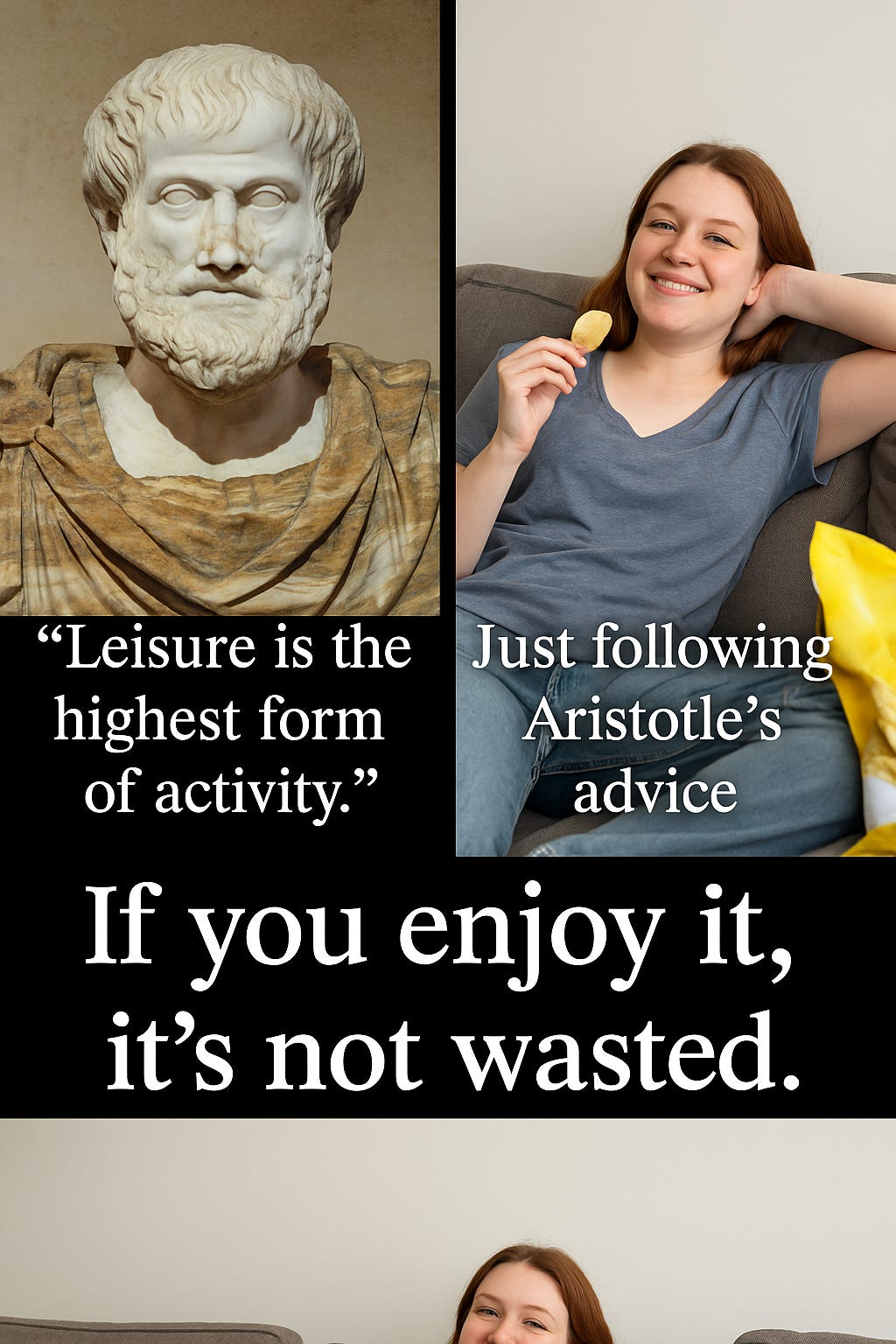
Wasting Time: The Guilty Pleasure We Don't Admit
We live in a culture where “doing nothing” is viewed as failure. We have productivity apps for everything—hydration reminders, steps, heart rates, and a digital to-do list that nags like an unpaid intern. And yet, when you look back, life’s best memories are often moments when nothing measurable happened. A slow morning. A meaningless road trip. Sitting on the porch watching light fade.
The question isn’t whether wasting time is wrong. The question is whether “wasting time” is the only time you’re truly alive.
Leisure as Civilization’s Secret Engine
The Greeks weren’t known for their work ethic. They invented democracy, philosophy, and theater—and did so largely while sitting around talking. Aristotle believed that leisure was the foundation of a good life. His term scholé (root of the word “school”) meant leisure devoted to thinking, conversing, and absorbing the world. In his view, work was what you did so you could get back to the more important task of living fully.
Aristotle would have laughed at our obsession with productivity metrics. He’d probably say, “You’re spending your life optimizing calendars instead of your soul.”
Taoism and the Power of Wu Wei
Meanwhile, in ancient China, Taoists were perfecting wu wei—the art of effortless action. Laozi taught that forcing things leads to chaos, while aligning with the natural flow of life leads to clarity. In modern terms: stop grinding and let your brain breathe.
A Taoist sage would look at someone working through lunch, chugging coffee, and panic-emailing and say: “You’re trying too hard. Sit down. The answer will find you.”
Religion’s Sacred Pause
Religions across centuries have formalized this concept.
The Sabbath isn’t just rest; it’s a spiritual declaration that life isn’t about constant output.
Islamic prayer cycles carve moments of reflection out of even the busiest days.
Buddhism prizes sitting in silence, stripping away all striving to simply be.
If “wasting time” were wrong, it’s odd how every tradition advises that stillness is divine.
The Neuroscience of Idleness
Modern science backs up what ancient wisdom already knew: when you’re idle, your brain doesn’t turn off—it reorganizes.
Serotonin: Stabilizes mood, creating a sense of quiet contentment.
Dopamine: Balances itself, reducing the manic “must-do” energy that drives stress.
Default Mode Network (DMN): This neural network ignites when you daydream or stare out the window. It’s responsible for insight, creativity, and connecting dots in ways your conscious brain can’t.
That “lazy” hour? Your mind is probably cooking up better ideas than when you’re forcing productivity.
History’s Loafers Who Changed the World
Newton: The story of gravity began with him lounging under an apple tree, not chained to a desk.
Einstein: His breakthroughs emerged from thought experiments—daydreams about riding alongside light beams.
Leonardo da Vinci: Famous for staring at rivers and clouds for hours, convinced that observation and “wasted” time would lead to genius. He wasn’t wrong.
The Roman Blueprint for Balance
The Romans divided time into negotium (business) and otium (leisure). Otium wasn’t indulgence—it was a necessity for thinking, writing, and personal growth. Cicero believed that a man without otium wasn’t fully human. Seneca, who had both wealth and wisdom, argued that it’s not how long you live, but how well you use your moments of leisure that matters.
The Industrial Revolution Stole Our Time
Factories and time clocks made idleness a sin. Time became “money,” and efficiency became religion. We still carry that industrial mindset—constantly optimizing, rarely pausing. But productivity without leisure isn’t life; it’s maintenance. We’re like hamsters on a wheel, mistaking speed for purpose.
What “Wasted” Time Does to the Body
When you slow down—nap, take a walk, watch a sunset—you flip your body’s switch from fight-or-flight to rest-and-digest. Cortisol levels drop. Blood pressure stabilizes. Your immune system resets. Idleness isn’t indulgence; it’s survival.
Think of yourself as a machine that needs scheduled downtime. If you never shut off, you don’t just burn out—you break.
Boredom as a Superpower
Boredom clears mental clutter. It’s the mind’s way of saying, let me process this chaos. That’s why big ideas strike in the shower or during long drives. It’s also why ancient thinkers—Socrates, Confucius, Buddha—valued stillness. They knew that silence and unstructured thought were fuel for breakthroughs.
Strategic Loafing: A Modern Manual
Guard Unstructured Time: Put “nothing” on your calendar and defend it like a national secret.
Reframe the Guilt: Leisure isn’t slacking; it’s creative incubation.
Micro-Loaf Daily: A 10-minute window of aimless daydreaming can boost problem-solving.
Leisure as Rebellion
Slowing down is now an act of defiance. It’s saying no to the relentless churn of emails, the pressure to optimize every second. It’s rediscovering that time is not just a commodity but a gift—one that doesn’t need to be spent “efficiently” to have value.
The Human Timeline
No one reflects on life wishing they spent more time updating spreadsheets. They remember the lazy days, the “wasted” time that made life feel wide and deep. Those moments are not wasted. They’re the only ones that count.
The Science-Backed Verdict
Studies from neuroscience and psychology confirm that downtime restores focus, improves memory, and strengthens emotional resilience. That 20 minutes spent lying on the floor with a pet, listening to music? It’s the cheapest therapy you’ll ever get.
Conclusion: Time Well Wasted
If you enjoyed the time, it wasn’t wasted. The Greeks, the Romans, the monks, the poets, the scientists—they all understood this. Leisure, idleness, stillness: these are not the opposite of life. They are life.
Field Guide to Guilt-Free Idleness
Schedule Play: Treat downtime like an appointment with your sanity.
Redefine Success: Measure life in moments felt, not tasks completed.
Take Micro-Rituals: A slow cup of tea, a porch sit, a quiet walk—call it therapy, because it is.
#TimeWellWasted #LeisureIsProductive #MindfulIdleness #SerotoninBoost #CreativeRest #WorkLifeWisdom #AncientLessons #ModernMindset #AristotleKnowsBest #TheJoyOfDoingNothing